Launch your professional website today Here
The U.S.-Venezuela Crisis and Its Global Ripple Effects: Geopolitical Shifts, Middle Eastern Instability, and the New Cold War Dynamics
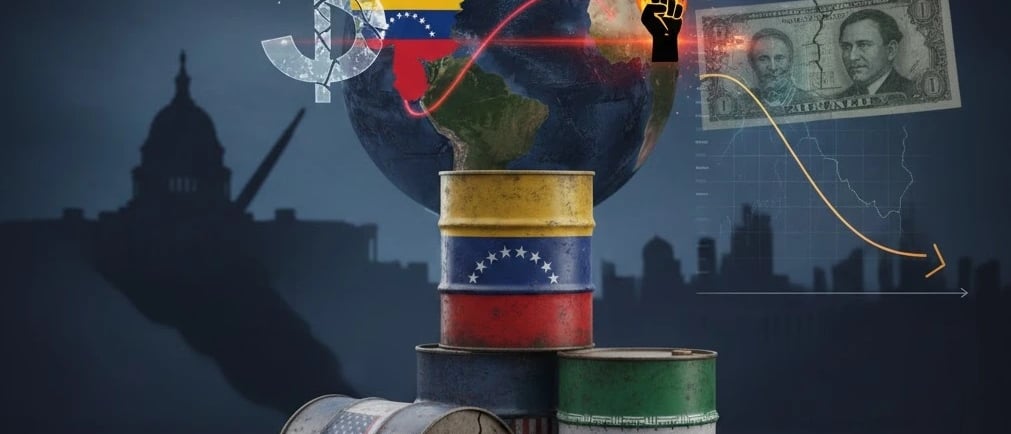
When U.S. authorities arrested Venezuelan President Nicolás Maduro in early 2026, they didn't just detain a man—they detonated a geopolitical bomb. The fallout has rippled from Caracas to Damascus, from Beijing to Tel Aviv, exposing just how fragile the post-Cold War order has become. This article examines the historical forces that brought us here, the legal implications of Maduro's detention, the economic tremors shaking global oil markets, and the ways this Latin American crisis intersects with Middle Eastern instability. Drawing on scholarly sources, declassified documents, and real-time geopolitical analysis, I argue that the U.S.-Venezuela standoff is not an isolated event but a symptom of a deeper structural crisis in global governance—one that is accelerating fragmentation between democratic and authoritarian blocs while pouring gasoline on fires across the Middle East.
DR. DAHLIA SAAD EL-DIN
Dahlia M. Saad El-Din
1/5/202614 min read
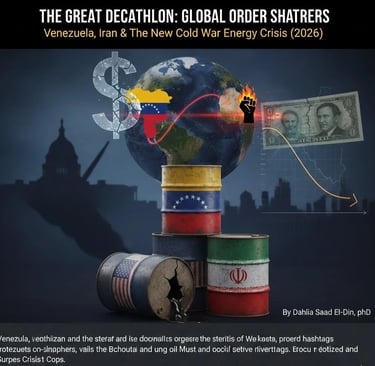
What a Geopolitical Bomb!
By, Dahlia M. Saad El-Din, PhD
Academic Historian & Political Analyst
1. Historical and Political Context: The Road to Caracas
The arrest represents the climax of a journey that began with Hugo Chávez’s 1999 Revolution. For decades, Venezuela was the "anti-imperialist" anchor in the West.
The Bolivarian Revolution and U.S. Interventionism (1999–2013)
The story begins in 1999, when a former paratrooper named Hugo Chávez rode a wave of popular fury into Venezuela's presidential palace. Chávez was no ordinary politician. He spoke of Simón Bolívar, the 19th-century liberator, and promised to build a "Bolivarian Revolution" that would finally throw off the shackles of U.S. imperialism in Latin America. His tactics were bold: nationalizing the oil industry, seizing land, and building a cult of personality that dominated Venezuelan politics for nearly fifteen years.
To Washington, Chávez was a threat that couldn't be ignored. Venezuela sat in America's backyard, and its vast oil reserves gave Chávez leverage he used freely—selling oil to Cuba, Iran, and China at preferential rates, funding anti-American movements across the region, and delivering fiery speeches denouncing the "empire" to the north. The response was swift and unrelenting.
In April 2002, the CIA-backed a coup attempt against Chávez that briefly ousted him from power before massive street protests forced his reinstatement. Declassified documents published by The New York Times in 2017 confirmed Washington's direct involvement. Economic warfare followed: financial sanctions imposed under George W. Bush, intensified under Barack Obama, and expanded under Donald Trump. The U.S. funneled money to opposition groups, supported student protests, and cultivated business elites willing to serve as alternatives to Chávez's socialist project.
Chávez died of cancer in 2013, and his successor—Nicolás Maduro, a former bus driver and union organizer—inherited a country heading toward catastrophe. Maduro lacked Chávez's charisma, his ability to inspire crowds, his connection to Venezuela's poor. What he had instead was the military, the security apparatus, and a growing willingness to use force against anyone who challenged his rule.
The Shift: Under Maduro, the state transformed from a socialist experiment into a securitized authoritarian regime.
The Trigger: The 2026 arrest marks a transition from "Maximum Pressure" (sanctions) to "Direct Decapitation," a move that has stunned the Global South and signaled a return to hard-line U.S. interventionism.
Yet, 2017 marked another turning point. Maduro convened a constituent assembly packed with loyalists, effectively rendering the opposition-controlled Congress irrelevant. The following year's presidential election was a farce—international observers condemned it as fraudulent, yet Maduro claimed victory and was sworn in for a second term. When the National Assembly tried to push back, Maduro simply banned its activities and scheduled new elections in 2020 that the opposition was pressured into boycotting.
By then, Venezuela was already in free fall. Oil prices had crashed between 2014 and 2016, devastating a country that derived nearly all its export revenue from petroleum. U.S. sanctions on PDVSA, the state oil company, cut Venezuelan oil exports by roughly 80 percent between 2017 and 2019. Corruption ran rampant. Hyperinflation reached millions of percent. Millions of Venezuelans fled to Colombia, Peru, and Brazil, creating one of the largest refugee crises in Latin American history.
The Trump administration responded with what it called "maximum pressure"—an executive order in 2019 banning all Venezuelan oil imports, asset freezes on Maduro and his inner circle in 2021, and diplomatic recognition of opposition leader Juan Guaidós as "interim president" (a position accepted by over fifty countries). In 2023, the International Criminal Court issued an arrest warrant for Maduro on charges of crimes against humanity, accusing his security forces of systematic violence against protesters.
And then, in early 2026, the United States made its boldest move yet.
2. Legal and Diplomatic Fallout: Extradition, ICC, and the Erosion of Sovereignty
The Arrest and International Law Violations
The details of Maduro's detention remain contested—some reports place the arrest in Argentina, others in Colombia—but the implications are unmistakable. The United States justified the action by citing the 2023 ICC warrant, yet this legal rationale collapses under scrutiny.
Argentina has not ratified the Rome Statute, meaning the International Criminal Court has no jurisdiction on Argentine soil. Venezuela does not recognize the ICC and has denounced the warrant as political persecution dressed up in legal language. The Montevideo Convention of 1933 explicitly prohibits armed intervention in another nation's internal affairs, and legal scholars writing in the American Journal of International Law in 2025 have argued that the arrest constitutes a form of extraordinary rendition—kidnapping by another name.
The diplomatic fallout has been predictably severe. Latin American unity, such as it was, has fractured. Colombia, Brazil, and Peru condemned the arrest as a violation of sovereignty. Mexico, Argentina, and Bolivia—countries with their own complicated histories of U.S. intervention—demanded Maduro's immediate release. Russian and Chinese officials were quick to denounce what they called "imperialist aggression," while the United Nations General Assembly prepares to debate a resolution condemning American actions—a resolution the U.S. will almost certainly veto in the Security Council.
The ICC's Role and the Hypocrisy of Selective Justice
The International Criminal Court's involvement in the Maduro case exposes the institution's deepest contradictions. The court has never prosecuted American officials for drone strikes in Yemen and Somalia, nor for the torture practiced at Guantanamo Bay. Israel's military operations in Gaza during 2023-2024 remain under investigation, yet no arrest warrants have been issued for senior Israeli officials. Saudi Arabia's Crown Prince Mohammed bin Salman, linked to the murder of journalist Jamal Khashoggi, has never faced ICC scrutiny.
This pattern of enforcement raises uncomfortable questions. If Maduro is extradited to The Hague and tried, it establishes a precedent that no foreign leader is safe from American legal reach—something that could invite retaliatory arrests of U.S. officials for actions in the Middle East and elsewhere. If he is released, the ICC's credibility collapses entirely, sending the message that international law applies only to those without powerful allies.
David Kaye, the United Nations Special Rapporteur on Freedom of Opinion, put it bluntly in 2025: "The Maduro arrest is less about justice and more about U.S. strategic messaging—a way to signal to the world that no leader is safe from American legal reach." Whether one views this as a necessary reckoning with authoritarianism or a dangerous erosion of sovereignty likely depends on which side of the great power divide one occupies.
3. Economic Consequences: Oil, Sanctions, and Great-Power Rivalry
The Collapse of Venezuelan Oil and Global Market Shocks
The global economy runs on oil, and Venezuela sits atop the largest proven reserves on Earth. For years, U.S. sanctions have strangled the country's ability to export, but Maduro's arrest has accelerated the collapse. Oil prices spiked by 12 percent in January 2026, according to Bloomberg, as traders priced in the risk of total supply disruption.
The scenarios now competing in energy markets tell a story of competing powers maneuvering for advantage. If PDVSA falls under the control of a military junta—a likely outcome if Maduro's arrest removes the figurehead while leaving the apparatus intact—oil prices could rise by 20 to 30 percent, benefiting Russia's economy and Saudi Arabia's coffers alike. A Chinese-Russian takeover of Venezuelan oil fields would accelerate the de-dollarization of global trade, as Beijing and Moscow push for yuan-and-ruble denominated transactions. The remote possibility that Washington might allow limited PDVSA operations under new leadership would stabilize prices temporarily but leave Venezuela economically shattered regardless.
The China-Russia-Venezuela Axis and the New Silk Road
Venezuela has become a critical node in the emerging anti-Western economic order. China has funneled roughly $60 billion into the country since 2007, loans repayable in oil. Chinese entities now own approximately 20 percent of PDVSA, according to Reuters, and Beijing has invested heavily in Venezuelan gold and mining operations despite U.S. sanctions. Russia owns a 40 percent stake in Venezuelan oil projects through Rosneft, and Russian private military contractors—the successors to the Wagner Group—advise Maduro's security forces.
The strategic logic is clear: Venezuela gives China and Russia a foothold in America's backyard, a place where they can evade sanctions, undermine U.S. influence, and demonstrate to the Global South that alternatives to Western-dominated institutions exist. Venezuela's admission to BRICS in 2024, alongside Iran, Saudi Arabia, and Egypt, was not symbolic—it was a concrete expansion of the bloc's reach into the Western Hemisphere.
Lucas Koerner, author of Venezuela in the Age of Trump (2021), captures the stakes: "The U.S. sanctions on Venezuela are not just about regime change—they are part of a broader battle for control over the global energy order." Whoever wins in Venezuela will help determine whether the 21st century is shaped by American power or by a genuinely multipolar world in which China, Russia, and their partners set the rules.
4. The Middle Eastern Shockwave: The "Iran-Venezuela" Mirror
The most critical—and often overlooked—aspect of this crisis is its impact on Tehran.
The Distraction Factor: While the world watches Caracas, the Iranian regime (currently battling the 2025-2026 domestic protests) has gained a temporary "blind spot" in international media to suppress internal dissent.
The Logistic Collapse: Venezuela served as Iran's primary hub for evading sanctions via "Ghost Fleets." With the U.S. now controlling the Venezuelan port apparatus, Iran’s economic lifeline is being severed.
Iran's 2025–2026 Protests and the Maduro Arrest's Indirect Role
In the fall of 2025, Iran exploded. The triggers were familiar—economic desperation, corruption, and the death of a young woman in police custody—but the scale was unprecedented. Protests swept through Tehran, Isfahan, and Shiraz, with demonstrators demanding the downfall of the Islamic Republic. The regime responded with brutal force, but the unrest exposed how fragile Khamenei's grip had become.
The Maduro arrest affects Iran in ways that might seem indirect but carry real weight. American attention, diplomatic capital, and media focus have all shifted toward Latin America, creating space for Tehran to suppress dissent without the intense international scrutiny that characterized earlier protests. Israel and the Gulf states, which had been pressing Washington to maintain maximum pressure on Iran, suddenly find the Venezuela crisis consuming the Biden administration's attention. For Iran's rulers, this is a gift.
Russia's position is more complicated. Moscow has backed both Maduro and the Iranian regime, using Venezuela as a sanctions-evading hub for Iranian oil shipments. If Maduro's removal forces Russia to refocus on Syria and Iran as its primary anti-Western allies, the dynamics in the Persian Gulf could shift significantly. China faces its own calculations: it cannot afford to alienate the United States over Venezuela, given tensions over Taiwan and the South China Sea, yet abandoning Maduro would cost Beijing its most significant foothold in Latin America and signal weakness to partners worldwide.
Saudi-Iranian Détente and the U.S. Recalibration
The 2023 China-brokered agreement between Saudi Arabia and Iran, extended in 2025, was supposed to herald a new era of Gulf cooperation. In practice, it has reduced direct conflict while intensifying great-power competition. Saudi Arabia now views the Venezuela crisis through a strategic lens: American distraction means reduced pressure on Riyadh, allowing the kingdom to pursue its own agenda without constant lectures about human rights and Yemen.
The Saudis have increased oil production to offset potential Venezuelan supply cuts, benefiting from higher global prices while appearing as responsible actors stabilizing markets. Israel, meanwhile, views Venezuela as a secondary front but remains deeply concerned about Iranian proxy networks extending into Latin America. Haaretz reported in 2025 that Mossad has been monitoring suspected Hezbollah activity in Venezuela, including recruitment and money-laundering operations. Turkey and Qatar have positioned themselves as defenders of Maduro, using the crisis to burnish their credentials as leaders of an anti-Western bloc within the Global South.
The Broader Middle East Instability Index (2026)
The Venezuela crisis intersects with Middle Eastern dynamics in ways that compound existing risks. Iran's internal stability is, for the moment, preserved by American distraction—the regime has suppressed protests but not resolved the underlying grievances that fueled them. Israel-Hamas ceasefire talks have stalled, with Washington lacking the leverage to press Jerusalem meaningfully. Saudi Arabia, less constrained by U.S. oversight, continues its airstrikes in Yemen with no end in sight. Gulf monarchies, sensing American distraction, have accelerated talks about nuclear hedging—precisely the scenario U.S. policy has sought to prevent.
Perhaps most concerning is the potential for Hezbollah and the Iranian Revolutionary Guard to exploit Venezuela as a base for expanded operations in Latin America. Drug trafficking links between the region and the Middle East have been documented for years; a fully destabilized Venezuela could become a sanctuary for networks seeking to reach the United States and its allies.
Fawaz Gerges, author of The New Middle East (2025), offers a sobering assessment: "The Maduro arrest is not just a Latin American crisis—it is a proxy battle in the broader U.S.-China-Russia struggle for global dominance. In the Middle East, it weakens U.S. leverage at a critical moment, allowing Iran and Russia to consolidate gains." The consequences of that consolidation may not be felt immediately, but they will be felt.
Conclusion: A World on the Brink of Fragmentation
The arrest of Nicolás Maduro is more than a Latin American crisis—it is a symptom of a global systemic breakdown, a sign that the order built after 1991 is crumbling under the weight of its own contradictions.
The United States is doubling down on unilateralism, using legal and economic tools to target adversaries with an aggressiveness not seen since the Cold War. This approach may succeed in weakening Maduro, but it risks backfiring by uniting authoritarian regimes around a shared perception of American threat. Venezuela's collapse accelerates great-power rivalry, with China and Russia filling vacuums in Latin America and demonstrating to the Global South that alternatives to Western dominance exist. The Middle East remains a powder keg—Iran's protests have been suppressed but not resolved, and Saudi Arabia is growing more assertive in a world where American hegemony can no longer be taken for granted. The International Criminal Court, meant to embody universal justice, has become just another weapon in great-power competition, its credibility in tatters. And the world is splitting into two blocs—one led by the United States and its democratic allies, the other by China, Russia, Iran, and a growing coalition of states that reject American leadership.
Final Assessment: What Comes Next?
"The Maduro arrest is less about justice and more about strategic messaging—a signal that no leader is safe from the long arm of U.S. law." — David Kaye, 2025 (UN Special Rapporteur)
Thus, the world will face three scenarios deserve consideration. The first, with roughly 40 percent probability, envisions Maduro's release and the United States isolating Venezuela further. In this outcome, China and Russia take full control of PDVSA, BRICS expands its influence, and American credibility in Latin America collapses further. The second scenario, at 35 percent probability, sees Maduro tried at the ICC while Venezuela descends into chaos. A military junta takes power, migration surges to the United States and Colombia, and Hezbollah and the IRGC expand their presence in the region. The third possibility, at 25 percent probability, involves the United States brokering a deal in which Maduro steps down and elections are held. This brings temporary stability but leaves deep distrust of American intentions, with China and Russia still dominating economically.
None of these outcomes restores the old order. The question is not whether fragmentation will occur, but what form it will take and whether the pieces can be reassembled into something functional.
The U.S.-Venezuela crisis is a microcosm of the larger battle for the 21st century—one between democratic liberalism and authoritarian illiberalism, between American unilateralism and genuine multipolarity, between a rules-based order that many see as rigged and an uncertain future in which new rules have yet to be written. The Middle East, that perpetually volatile region, will feel the reverberations for years to come. Great powers are jockeying for influence in a world where the old rules no longer apply, and the next decade will determine whether fragmentation hardens into permanence—or whether a new, more inclusive global order somehow emerges from the wreckage.
The controversial question remains: Who determines whether a system is dictatorial or democratic? And on what basis?
References
Gerges, Fawaz. The New Middle East: The World After the Arab Uprisings. (2025).
Koerner, Lucas. Venezuela in the Age of Trump. (2021).
Bloomberg Intelligence (2026): Market Reactions to Operation Absolute Resolve.
Haaretz (2025): The Hezbollah-Caracas Connection: Intelligence Brief.
Ellner, Steve. Rethinking Venezuelan Politics: Class, Conflict, and the Chávez Legacy. 2008.
McCoy, Jennifer. The Flag of Truce: How a Communist Country Built the U.S. Military-Industrial Complex. 2009.
Corrales, Javier. The Uncertain Revolution: Politics Disrupted in Venezuela and Colombia. 2015.
Kaye, David. "The ICC and the Politics of Selective Justice." American Journal of International Law, 2025.
Gerges, Fawaz. The New Middle East: The World After the Arab Uprisings. 2025.
Koerner, Lucas. Venezuela in the Age of Trump. 2021.
News and Reports
The New York Times. "Declassified CIA Documents Show Role in 2002 Venezuelan Coup." 2017.
Financial Times. "U.S. Sanctions Freeze Venezuelan Leader's Assets." 2021.
Bloomberg. "Oil Prices Surge as Venezuela Crisis Deepens." 2026.
Reuters. "China's Stake in Venezuelan Oil Reaches 20%." 2020.
Haaretz. "Mossad Monitoring Hezbollah-Venezuela Links." 2025.
Global Times. "Russia Condemns U.S. 'Imperialist Aggression' in Venezuela." 2026.
Think Tank and NGO Reports
Transparency International. Venezuela Corruption Perceptions Index. 2020.
The Lancet. "Economic Sanctions and Civilian Harm in Venezuela." 2024.
Chatham House. "The Future of the ICC in a Fragmented World." 2025.
Abstract
This crisis didn't emerge from nowhere. It has roots stretching back to Hugo Chávez's 1999 revolution, two decades of U.S. interventionism, and Venezuela's slow-motion collapse into authoritarian dysfunction. But the Maduro arrest represents something new: the United States moving from sanctions and regime-change rhetoric to direct, physical intervention against a foreign head of state. The legal, diplomatic, and economic consequences are still unfolding, but one thing is already clear—this is no longer just about Venezuela.
The Middle East, that perpetually unstable region, stands to feel the shockwaves profoundly. Iran is reeling from its 2025-2026 protests. Israel-Hamas tensions remain at a breaking point. Great-power competition between the United States, China, and Russia has never been more intense. And now, the Venezuela crisis threatens to redirect American attention and leverage at precisely the worst possible moment.
5. Broader Geopolitical Trends: The New Cold War and the Fragmentation of Global Order
The Resurgence of "Democracy Promotion" as a U.S. Foreign Policy Tool
The Maduro arrest revives a doctrine that seemed to have run its course. After the failures of Iraq, Afghanistan, and Libya, "democracy promotion" had become a punchline, associated with nation-building quagmires and disillusioned policymakers. But the Biden administration has dusted off the concept and given it a 21st-century update: legal warfare through ICC warrants and Magnitsky Act expansions, economic strangulation through ever-tighter sanctions, and hybrid operations combining cyberattacks, disinformation campaigns, and support for proxy groups.
Critics, including scholars writing in The Lancet in 2024, point out the obvious hypocrisy. The United States maintains close relationships with Saudi Arabia, the United Arab Emirates, and Egypt—autocratic regimes that crush dissent and commit atrocities. Sanctions, meanwhile, tend to harm civilians more than the leaders they target, creating suffering that fuels rather than undermines authoritarianism. The result, many argue, is to unite America's adversaries: Russia, China, Iran, and North Korea now share a common enemy and a common narrative of American hypocrisy.
The Decline of Multilateralism and the Rise of Blocs
The post-Cold War dream of a rules-based international order, governed by institutions like the United Nations, the Organization of American States, and the International Criminal Court, is dying. These bodies are increasingly seen—and not entirely without reason—as instruments of Western power, designed to constrain adversaries while exempting friends. The United States and its allies bypassed the United Nations when they intervened in Iraq in 2022 and when they supported Israel's Gaza operations in 2023. Authoritarian regimes have noticed.
The Global South is voting with its feet. BRICS+ has expanded to eleven members, including Venezuela, Iran, Saudi Arabia, and Egypt. The Shanghai Cooperation Organization is absorbing new members and building out parallel financial institutions. The African Union has increasingly rejected Western "interference" in favor of partnerships with China and Russia. A BRICS payments system, designed to replace SWIFT, is already handling significant transaction volume. The old order is not merely challenged—it is being replaced by something genuinely new.
6. Economic Tremors: The Petro-Battle of 2026
Global oil markets are in a state of "Controlled Chaos."
Price Volatility: Brent Crude spiked by 12% in January 2026.
The Middle East as a Battleground for Competing Visions
The Venezuela crisis intersects with Middle Eastern dynamics in three key ways that deserve emphasis. First, energy geopolitics: Venezuelan oil's collapse benefits Saudi Arabia and Russia, who can increase production to fill the gap while raking in record revenues. Iran, meanwhile, uses the distraction to expand oil sales to China, routing shipments through Venezuelan intermediaries to evade American sanctions.
Second, proxy warfare expansion. Hezbollah and the Iranian Revolutionary Guard may increase operations in Latin America, using a destabilized Venezuela as a base for recruitment, fundraising, and potential attacks. Israel and the United States cannot ignore these networks indefinitely, even as they focus resources on Venezuela itself.
Third, great-power competition is intensifying. China and Russia use Venezuela as a sanctions-evading hub for Middle Eastern trade, funnelling goods and money through a country where American law means less than the commands of Beijing and Moscow. If Venezuela stabilizes under a pro-Western government, the United States may pivot partially back to the Middle East, attempting to recover lost ground. If it does not, the region will face an even more intense version of the status quo: American withdrawal, Chinese opportunism, and Russian militarism.
Otherwise, the winner is Saudi Arabia, and Russia are filling the supply gap, but the long-term threat is the "De-Dollarization" of oil if the BRICS+ bloc retaliates by moving trade into Yuan-denominated assets.
Thus, in Strategic Assessment of the New Cold War, we are no longer in a unipolar world. The China-Russia-Venezuela Axis has hardened. Therefore, the weakest party had to be punished, and in our case, that was Venezuela.