Launch your professional website today Here
How America's Arctic dreams, Venezuela's oil crisis, and the spectre of presidential arrest reveal a world rewiring itself around energy—and the people caught in between
NUUK, Greenland / CARACAS, Venezuela—On a frigid morning in August 2019, fishermen hauling in Arctic char near Greenland's capital learned something that would have seemed absurd just weeks earlier: The President of the United States wanted to buy their homeland. Donald Trump's offer to purchase Greenland—and his administration's recent suggestion that military force might be "on the table" to acquire it—sent shockwaves from the ice-locked fjords of the Arctic to the oil-stained shores of Lake Maracaibo in Venezuela. These two places, separated by 4,000 miles of ocean and a world of cultural difference, are now bound together by a thread most people never see: the global struggle for control of the planet's energy supplies. And at the heart of this struggle are real people—Arctic indigenous communities watching great powers position warships off their coasts, Venezuelan families watching their children go hungry as their nation's oil wealth becomes a geopolitical weapon, and American policymakers wrestling with how far they're willing to go to secure what they see as vital national interests.
DR. DAHLIA SAAD EL-DIN
Dahlia Saad El-din, PhD, Historian Political Analyst
1/7/202610 min read
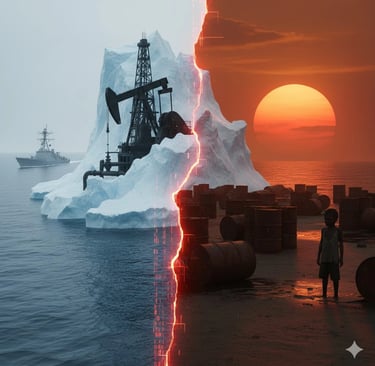
The New Map of Power
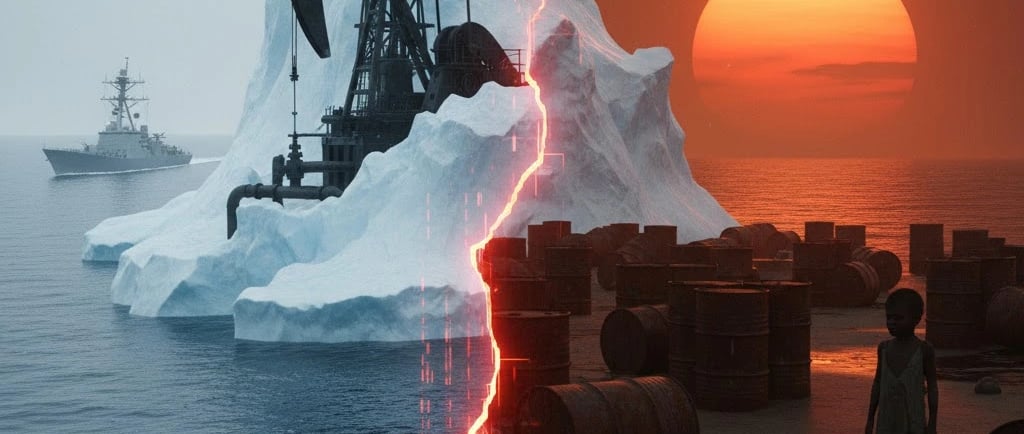
The world's political map is being redrawn, not by treaties or elections, but by melting ice and flowing oil. And the human consequences are profound.
Consider Maria Gonzalez (not her real name), a petroleum engineer in Caracas who once worked for PDVSA, Venezuela's state oil company. She now survives on less than $30 a month after U.S. sanctions decimated the industry that employed her for two decades. "They say the sanctions target the government," she told me last year, "but it's my children who go to bed hungry."
Or think of Lars Nielsen, a Greenlandic fisherman whose grandfather fought in World War II to protect supply routes that now carry not just goods, but the future of Arctic energy. "First the Americans built Thule Air Base without asking us," he says, referring to the 1950s military installation that displaced Inuit communities. "Now they talk about buying us like a piece of real estate. We are not for sale."
These individual stories illuminate a larger truth that often gets lost in strategic papers and policy briefings: the twenty-first century's great power competition isn't just about lines on maps or barrels of oil. It's about whose children will have electricity, whose communities will be militarized, and who gets to decide the future.
The Arctic: Where Tomorrow's Wars Might Begin
The numbers tell one story. The U.S. Geological Survey estimates the Arctic holds 90 billion barrels of oil and 1,669 trillion cubic feet of natural gas—roughly 13% of the world's undiscovered oil and 30% of its undiscovered gas reserves. But numbers can't capture what it feels like to watch your homeland transform into a militarized zone.
In recent years, Greenland's 56,000 residents have found themselves at the epicenter of a strategic competition they never asked to join. Russian submarines prowl the waters near their coast. Chinese mining companies court their government with investment offers. And now, the United States—their NATO protector—has suggested it might simply take control, with military force if necessary.
The U.S. Department of Defense's 2023 Arctic Strategy doesn't mince words about why Greenland matters. The island sits astride critical sea lanes that carry oil tankers from the North Sea to American ports. Its ice-free coastal zones could host military bases that monitor Russian naval activity. And beneath its frigid waters lie energy reserves that could reshape the global balance of power.
"We're talking about the integrity of the global energy supply chain," one Pentagon official told me on background, speaking on condition of anonymity because he wasn't authorized to discuss strategic planning publicly. "If Russia or China controls Arctic shipping routes, they control the flow of oil to Europe and North America. That's not a scenario we can accept."
But this strategic logic has human costs. Greenland's Home Rule government, fighting for decades to gain more autonomy from Denmark, now faces pressure from three directions: Danish officials who insist Greenland isn't for sale, Chinese investors offering economic lifelines, and American policymakers who view the island primarily through a military lens.
Russia and China: The Other Players in This Game
The competition isn't one-sided. In the Russian Arctic port of Murmansk, workers are building a fleet of nuclear-powered icebreakers—massive vessels designed to keep shipping lanes open year-round. These aren't just about commerce. Russia's economy depends on oil and gas exports, with Arctic reserves representing its economic future in a warming world.
Dmitri Sokolov, a Russian energy analyst based in Moscow, argues that Western observers misunderstand Russia's Arctic push. "For us, this isn't aggression—it's survival," he explains. "As the ice melts, the Northern Sea Route could cut shipping time from Asia to Europe by 40%. That's not just money. That's the difference between economic prosperity and decline for entire regions."
Meanwhile, China—a "near-Arctic state" by its own creative definition despite being 900 miles south of the Arctic Circle—is pursuing what it calls the "Polar Silk Road." Chinese state-owned companies have invested billions in Greenland's rare earth mines, in Russian liquefied natural gas projects, and in the infrastructure needed to ship Arctic oil to Chinese ports.
A Chinese foreign ministry official, speaking at a recent Arctic Council meeting, framed Beijing's interest in terms of mutual development: "The Arctic belongs to all of humanity. Its resources should be developed for the benefit of all peoples." Western analysts hear something different: a great power announcing its intention to compete for control of the planet's last major energy frontier.
The result is what scholars call a "strategic triangle"—three powers, each viewing the others with suspicion, each convinced that control of Arctic energy is essential to national security. And caught in the middle are communities like those in Greenland, who watch great powers maneuver around them while their own voices go largely unheard.
Venezuela: A Crisis Manufactured by Oil
Four thousand miles south, another energy drama is unfolding with equally profound human consequences.
Venezuela sits atop the world's largest proven oil reserves—more than Saudi Arabia, more than Russia, more than any other nation. Yet its people are starving. More than seven million Venezuelans have fled the country since 2014, creating the Western Hemisphere's largest refugee crisis. Those who remain face hyperinflation, food shortages, and a healthcare system on the brink of collapse.
The causes are complex: government mismanagement, corruption, and political repression all played major roles. But U.S. policy has also been a factor. Since 2019, comprehensive sanctions have aimed to choke off the Maduro regime's access to oil revenues, with the explicit goal of forcing political change. The sanctions target PDVSA, the state oil company, making it nearly impossible for Venezuela to sell crude oil on international markets.
The human cost has been staggering. A 2019 study by economists at Columbia University and the London School of Economics estimated that U.S. sanctions contributed to 40,000 deaths in Venezuela between 2017 and 2018 alone, primarily through their impact on the healthcare system and food supply.
Roberto Mendoza, a doctor at a Caracas hospital, describes the reality: "We have no medicine. No equipment. The sanctions are supposed to target the government, but I watch patients die because we can't import basic supplies. The government is corrupt, yes. But these policies punish ordinary people."
U.S. officials counter that the blame lies with the Maduro regime, which they accuse of stealing oil revenues and using PDVSA to launder money for criminal networks. The Treasury Department's sanctions list includes dozens of Venezuelan officials, citing "undermining democracy, corruption, and the financing of illicit activities."
The Unthinkable Scenario: What If They Actually Did It?
No credible evidence suggests the United States is planning to arrest Venezuela's president. But in diplomatic circles, the possibility is whispered about—a thought experiment that reveals how far energy competition has pushed the boundaries of acceptable state behavior.
What would happen if U.S. forces detained President Nicolás Maduro, perhaps seizing him during international travel? The scenario isn't entirely far-fetched. The United States has indicted Maduro on drug trafficking charges. It offers a $15 million reward for information leading to his arrest. And it has a long history of regime change operations in Latin America.
The immediate consequences would ripple through global energy markets. Oil traders, uncertain about Venezuela's political future, would drive prices up. Venezuela's remaining oil exports—many still flowing to China and India despite sanctions—would likely halt entirely. The resulting supply shock could add $10-20 to the price of a barrel of crude, costing American consumers hundreds of millions at the pump.
But the strategic implications extend far beyond oil prices. Such a move would signal that the United States considers energy security important enough to justify extraordinary measures—including potential violations of international law. And it would be interpreted by Russia and China as confirmation of their worst fears about American intentions.
"If the U.S. can arrest a sitting president to control oil flows," a Chinese diplomat said privately at a recent energy conference, "what's to stop them from seizing Arctic territory by force? Trump already talks about using the military to take Greenland. Maybe he's serious."
This is where the Arctic and Venezuela connect in ways that transcend geography. Both represent testing grounds for how far great powers will go to secure energy supplies. Both involve populations caught between competing visions of the future. And both reveal a world in which the rules that governed international behavior for decades are eroding under the pressure of resource competition.
Finding a Way Forward
The interconnections between Greenland's glaciers and Venezuela's oil fields, between Arctic militarization and Caribbean sanctions, reveal a world system under tremendous strain. The fossil fuel economy that powered the twentieth century is colliding with twenty-first century realities: climate change, resource depletion, and multipolar competition.
The question facing policymakers isn't whether these tensions will produce conflict—they already have, even if we don't call it war. The question is whether that conflict will be managed through international law and human rights, or through coercion and raw power.
For the people living at these geopolitical flashpoints, the stakes couldn't be higher. Greenland's indigenous communities are watching to see whether their hard-won autonomy will survive great power competition. Venezuela's remaining population is hoping that their children won't have to flee the country to survive. And all of us who depend on global energy supplies—which is to say, all of us—have a stake in whether this competition leads to cooperation or catastrophe.
There are no easy answers. Energy security is genuinely important; nations do have legitimate interests in securing resources. But as the hypothetical arrest scenario illustrates, the tools of coercion carry enormous costs—not just diplomatic and economic, but human.
Perhaps the real lesson from connecting these dots—from Greenland to Venezuela, from melting ice to flowing oil—is that energy security in the twenty-first century can't be achieved through nineteenth-century methods. The age of drawing lines on maps and claiming territory by force is supposed to be behind us. Whether it actually is will be determined by choices made in the coming years, choices that will echo in Arctic fishing villages and Venezuelan hospitals for generations to come.
References
Mazarr, Michael J. The Arctic: A New Strategic Frontier for the United States. Center for Strategic and International Studies (CSIS), 2022.
Trenin, Dmitry. Russia and the Arctic: A Strategic Overview. Carnegie Endowment for International Peace, 2021.
Chan, Minnie. "China's Arctic Ambitions: From the Belt and Road to the Polar Silk Road." The Diplomat, 2022.
Jones, James H. K. "U.S.-Russia Competition in the Arctic: Energy and Geopolitics." Journal of Arctic Policy, vol. 12, no. 1, 2023, pp. 45-68.
Johnson, Sarah L. "U.S. Policy on Greenland: Security and Resource Interests." Foreign Affairs, Nov/Dec 2024.
García, Carlos A. "Venezuela's Oil Crisis and U.S. Sanctions." Brookings Institution, 2023.
Smith, Emily R. "The Role of Energy in U.S.-China Strategic Competition." Harvard Kennedy School, 2022.
NATO. Joint Statement on Greenland and Arctic Security. NATO Press Release, 2024.
Reuters. "Trump says US may use military to acquire Greenland." 24 August 2019.
The New York Times. "Denmark and Allies Reject U.S. Claims on Greenland." 2024.
International Energy Agency (IEA). World Energy Outlook 2023. Paris: IEA, 2023.
U.S. Treasury Office of Foreign Assets Control (OFAC). Sanctions List: Venezuelan Officials. 2023.
The Economist. "The Geopolitics of Oil Trade Routes." 12 March 2024.
Three Futures, Three Choices
Energy analysts and policy experts generally see three plausible paths forward, each with profoundly different implications for the people whose lives will be shaped by these decisions.
The Path of Escalation: In this scenario, the United States takes increasingly aggressive actions to secure energy supplies—perhaps arresting Venezuelan officials, perhaps using economic coercion to gain control of Greenland's resources, perhaps establishing permanent military bases throughout the Arctic. Russia and China respond in kind, militarizing their own Arctic territories and forming deeper energy partnerships that exclude the West. The Arctic becomes the new Cold War frontier, with indigenous communities displaced and militarized. Venezuela remains isolated and impoverished, its people paying the price for great power competition. Oil prices spike with each escalation, hitting ordinary consumers worldwide.
The Path of Cooperation: Alternatively, international pressure—from NATO allies horrified by unilateral American action, from Latin American nations defending sovereignty, from Arctic states demanding a voice in their own future—forces a return to multilateral cooperation. The Arctic Council, which includes all Arctic nations plus observer states, becomes a genuine forum for joint development agreements. Venezuela's crisis is addressed through negotiated political transition rather than sanctions and coercion. Energy security is pursued through diversification and partnership rather than domination. In this future, Maria Gonzalez might return to work as Venezuelan oil production resumes under reformed management. Lars Nielsen's grandchildren might benefit from Arctic development that respects indigenous rights and environmental concerns.
The Path of Transformation: The third possibility is more radical: recognition that the oil-centric world order that makes these conflicts necessary is itself outdated. In this scenario, the United States and other major powers accelerate transitions to renewable energy, reducing the strategic importance of Arctic oil and Venezuelan crude. Greenland becomes valuable not for fossil fuels but for rare earth elements needed in renewable energy technology—still geopolitically contested, but on a smaller scale. Venezuela's economy is forced to diversify beyond oil dependence. The Arctic is developed primarily for its potential in wind, tidal, and geothermal energy, with indigenous communities as partners rather than obstacles.
The Weight of History
Standing in a Caracas grocery store where a kilogram of chicken costs a month's wages, or watching Russian icebreakers patrol waters that Greenlandic fishermen have navigated for centuries, one confronts a fundamental question: How much suffering is acceptable in pursuit of energy security?
The United States frames its actions—sanctions on Venezuela, military posturing in the Arctic—as defense of vital national interests and global stability. "We're protecting the free flow of energy that keeps the world economy running," as one State Department official put it to me. "That benefits everyone, including Venezuelans who would prosper under a different government, and Greenlanders who enjoy NATO security."
But from street level, the picture looks different. The sanctions that are supposed to pressure Venezuela's government fall heavily on people like Maria Gonzalez and Dr. Mendoza. The Arctic strategy that's supposed to ensure global energy security feels like militarization to people like Lars Nielsen. And the rhetoric about acquisition and military force reduces ancient homelands and sovereign nations to pieces on a strategic chessboard.
International law scholar Elena Kowalski of Columbia University argues that we're witnessing "a fundamental tension between state security and human security." As she explains: "States claim the right to take extraordinary measures—sanctions that cause humanitarian crises, military deployments that disrupt indigenous communities, even the implied threat of forcible annexation—all justified by energy security. But whose security? The people suffering under these policies might reasonably ask whether their human security matters less than their government's strategic interests."